


MACAULAY, Thomas Babington
The History of England, from the Accession of James II
The History of England, from the Accession of James II
London: The Folio Society, 2009
Illustrated by
Couldn't load pickup availability
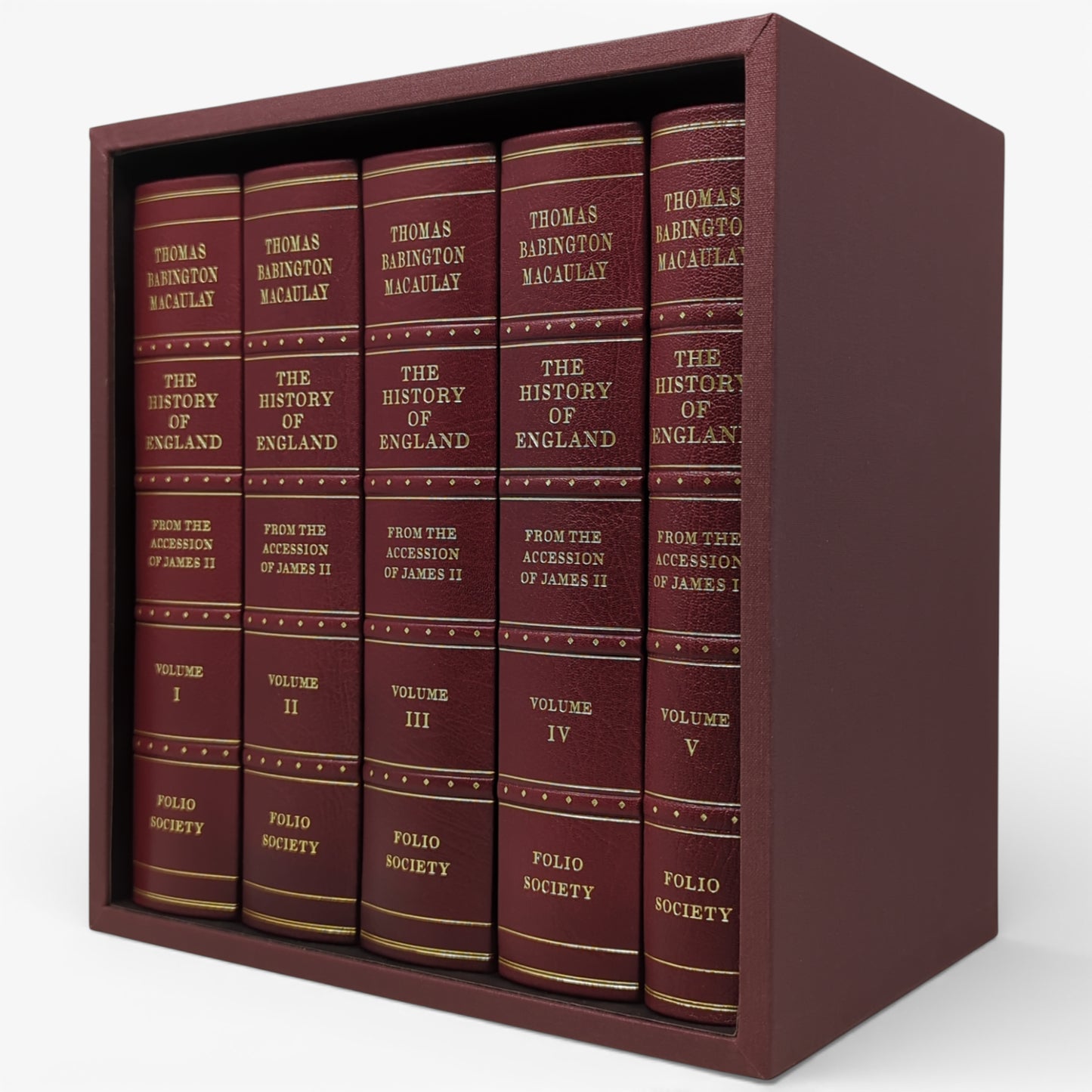
MACAULAY, Thomas Babington. The History of England, from the Accession of James II. Introduced by Peter Rowland, and with a newly commissioned foreword by Richard J. Evans, Regius Professor of Modern History, University of Cambridge. London: The Folio Society, 2009.
Limited and Numbered Edition, one of strictly 500 copies that were issued bound in full dark red goatskin leather tooled with gold on traditional raised bands, top-edge gilding, dark red endleaves and dark-red wooden and cloth-bound slip case. 5 volumes. 10" x 6¼". Set in Baskerville. 2,696 pages with 72 pages of colour and black & white illustrations. Printed by Memminger Medien Centrum. Bound by Real Lachenmaier. The five volumes are as follows:
- Volume I . . . foreword by Richard J. Evans . . . Pp. [i–v] vi–xxxiii [xxxiv], [1] 2–526: [9] leaves of colour plates (facing p. [iii] and between pp. 110–111 and 350–351).
- Volume II . . . Pp. [i–v] vi–xviii, [1] 2–542: [9] leaves of colour plates (facing p. [iii] and between pp. 110–111 and 350–351).
- Volume III . . . Pp. [i–v] vi–xxvi, [1] 2–582: [9] leaves of colour plates (facing p. [iii] and between pp. 102–103 and 406–407).
- Volume IV . . . Pp. [i–v] vi–xxxiv, [1] 2–661 [662]: [9] leaves of colour plates (facing p. [iii] and between pp. 110–111 and 430–431).
- Volume V . . . Pp. [i–v] vi–xxiii [xxiv], [1] 2–244 [245–248]: [5] leaves of plates (facing p. [iii] and between pp. 120–121).
"To do justice to the book’s exceptional stature, we have produced a superb edition, which will grace any book collection." (The Folio Society)
Condition
The volumes are in near-fine, close-to-immaculate condition, with perhaps ever-so-slight discolouration to the leather on the spines (only visible in held in plenty of light). Else this is a fine set in like slipcase, the latter with most minimal shelf-wear.
One of the greatest and most influential works of history
In the first half of the 19th century, Europe was convulsed by revolution: in France, Spain, Germany, Hungary and Italy, kings were deposed, governments rose and fell, blood was spilt. Britain, it seemed, was uniquely fortunate in having avoided such tumult. It took the brilliant politician and man of letters Thomas Babington Macaulay to ask: How was it that Britain remained peaceful, while, as he put it, ‘the proudest capitals of Western Europe have streamed with civil blood’? For Macaulay, the answer was to be found more than 150 years before, in the short period of British history following the ‘Glorious Revolution’ of 1688, when the British Parliament ousted one king and chose another, without the country descending into civil war. Macaulay made his case in one of the most successful and brilliant histories ever written.
‘Start off on any page, in the middle of a paragraph, and it is impossible not to read on’ (A. J. P. TAYLOR)
A peerless study of how modern democracy was forged
Macaulay’s History of England covers the period from 1685 to 1702 – a period about which little had been written before. In Macaulay’s view, this brief interval was the crucible of British democracy and gave us the free press, individual liberty and religious tolerance. Beginning with James II’s troubled reign, Macaulay unravelled the complex web of 17th-century politics and shifting public opinion, to show how tension mounted through the Monmouth rebellion and its aftermath, until, at last, a united Lords and Commons proclaimed William and Mary sovereign. War on the Continent and in Ireland followed, but William III, the hero of Macaulay’s history, steered the nation through turbulent times, maintaining a balance between opposing religious and political groups until his death in 1702.
Macaulay’s gripping account did not confine itself to Parliament and battlefields, but roved through coffeehouses, corn exchanges and prison cells. There are unforgettable images: the infamous Bloody Judge Jeffreys disguised as a sailor with eyebrows shaved off in a fruitless attempt to evade the mob; the desperate survivors of Glencoe mourning their dead around the charred remains of their homes; the plain squire who stood up in Parliament to criticise lawyers who ‘for a guinea … prove that black was white’; Queen Mary fleeing Whitehall in an open skiff on a stormy night. As a Whig politician, Macaulay was deeply committed to the cause of liberty and reform, and his passionate conviction gives his history an extraordinary drama and depth.
An unmatchable style and passionate eloquence
Macaulay was one of the greatest parliamentary orators of his day. Even his political opponents admired his handling of language, and his great speech on the 1st Reform Bill still resonates: ‘There is a change in society. There must be a corresponding change in government.’ His powers of oratory are matched by his written eloquence. Lively, clear, energetic, vivid, elegant – Macaulay’s prose is a joy to read. Winston Churchill famously emulated Macaulay’s ‘crisp and forcible’ voice, while passages of Macaulay were the standard inclusion in style guides for generations.
First published in 1848‒55, Macaulay’s History was an instant bestseller, with printers unable to keep up with the demand for copies. As a historian he was in total command of his material – his ‘near perfect recall’ and capacity to analyse and deploy vast quantities of information ensured that his life’s work, even though unfinished at his death, was hailed as a masterpiece, and set a new standard for future historians, both in terms of scholarship and style.
A historian of genius who still fascinates today
Macaulay was one of the first writers to draw on contemporary news-sheets, tracts and ballads as source material for his history. He greatly admired the novels of Sir Walter Scott, and believed that historians should learn from the dramatic techniques of novelists. This outlook gave him the ability to enter into the spirit of the times and convey what it was actually like to live through them – a revolutionary approach which would captivate readers, while his shrewd grasp of politics gave added power to his account. For its scope, its drama and its conviction, Macaulay’s history remains as exhilarating to read as it was when it was first published.
‘It is doubtful whether any historical work of our time has had a circulation or direct influence comparable with … Macaulay’s History of England.’ (F. A. HAYEK, Nobel Laureate)
About Thomas Babington Macaulay 1800‒59
The son of an abolitionist, Thomas Babington Macaulay had an early interest in politics. He was educated at Trinity College, Cambridge, and won several prizes, including the Chancellor’s Gold Medal. He was called to the bar, but preferred politics and in 1830 became an MP.
In 1834 he travelled to India to serve on the Supreme Council. He promoted the use of English in education and created a penal code which was enacted in the aftermath of the Indian ‘Mutiny’ of 1857. Later he became MP for Edinburgh, serving as Secretary of War, Paymaster General and working on copyright law. In 1857 he was raised to the peerage but he retired from politics to devote himself fully to writing. He is buried in Poets’ Corner in Westminster Abbey.
‘Macaulay has a fair claim to being the most influential of the British classical liberals, and few would dispute that he’s the most fun to read’ (WALTER OLSON, Fellow of the Manhattan Institute)
Careful Packaging
Careful Packaging
We provide secure and careful wrapping to ensure that your book will arrive in the exact condition that is described in the listing.
If one or more items in your order will be a gift, please let us know when checking out, and we will make sure not to add an invoice. You are also welcome to let us know if you would like us to include a special, customised message with your parcel.
Shipping & Returns
Shipping & Returns
All orders placed before 18:00 on a working day are despatched the next working day unless otherwise advised. Orders placed after 18:00 on a working day will be despatched within the next two working days. The shipping fee is calculated at check-out based on parcel weight and destination. A tracking number will be provided once the order is ready for despatch.
If you order items from our site for international delivery, please note that your order may be subject to import duties and taxes which are applied when the delivery reaches your destination. Please note that we have no control over these charges and we cannot predict their amount. You will be solely responsible for payment of any such import duties and taxes.
We do our best to describe items as accurately as possible. All our books can be returned within 14 days of receipt, whether they have been found to be not-as-described or you have simply changed your mind about the purchase. Returns are only free when items have been found to be not as described. Please see our Terms and Conditions for more details.
Tax and Import Duties
Tax and Import Duties
If you order items from our site for international delivery, please note that your order may be subject to import duties and taxes which are applied when the delivery reaches your destination. Please note that we have no control over these charges and we cannot predict their amount at check-out. You will be solely responsible for payment of any such import duties and taxes.
Should you prefer to know these additional charges and pay them in advance, you are welcome to purchase from us via eBay, our marketplace site. This way, you will be able to pay all postage, taxes and import charges upfront at check-out, so you will not have to worry about any extra charges or additional paperwork when your items are delivered. However, please note the eBay estimations tend to be higher than what your courier would normally charge, and our items' prices are also slightly higher in order to reflect the fees that eBay charge us. If you visit our eBay shop and cannot find the edition you are looking for, please feel free to write to us and let us know which; we'll do our best to help.
Ask Us a Question
Ask Us a Question
If you have any questions about this book, please send us a message or write to us at hello@sanchosrarebooks.co.uk, and we will make sure to get back to you as soon as possible with further information. Please do mention to which edition you are referring in your message, either by name or by including a direct link to our listing.
We take great care in pricing our books fairly from the outset and while we very much appreciate your interest, please note that in most cases we do not accept offers for our existing stock. We do review prices periodically and reduce when appropriate, so if something is of interest but not quite within budget, it is always worth keeping an eye on it, as it may be reduced later.


Notes from the bookshop
-

Item Spotlight: A Box of Delights Within a Box ...
An item spotlight on one of our most magical offerings: the first editions of The Midnight Folk (1927) and The Box of Delights (1935) by John Masefield, both in their...
Item Spotlight: A Box of Delights Within a Box ...
An item spotlight on one of our most magical offerings: the first editions of The Midnight Folk (1927) and The Box of Delights (1935) by John Masefield, both in their...
-
Through the Flames and Down the Rabbit Hole: A ...
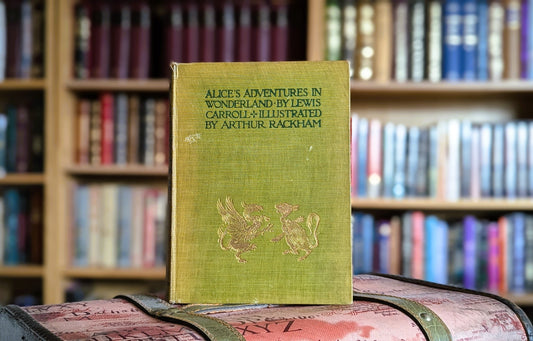
Introducing one of our latest acquisitions: the first trade edition of Alice's Adventures in Wonderland illustrated by Arthur Rackham, purchased, as per its easily recognisable blind bookstamp, from Poughkeepsie's famous...
Through the Flames and Down the Rabbit Hole: A ...
Introducing one of our latest acquisitions: the first trade edition of Alice's Adventures in Wonderland illustrated by Arthur Rackham, purchased, as per its easily recognisable blind bookstamp, from Poughkeepsie's famous...
-
Step into the World of Arthur Rackham
We are very excited to announce that Sancho's Rare Books has recently acquired a truly enchanting collection of books illustrated by the legendary Arthur Rackham. From the early American tale...
Step into the World of Arthur Rackham
We are very excited to announce that Sancho's Rare Books has recently acquired a truly enchanting collection of books illustrated by the legendary Arthur Rackham. From the early American tale...

Explore the World of Sancho's Rare Books
Rare First Editions, Fine Bindings, Limited Books, Signed and Inscribed Titles
We buy and sell first edition books, rare, limited, signed and inscribed titles, fine and beautiful bindings, private and fine press books, including Folio Society, Lyra's Books, Golden Cockerel, Limited Editions Club, Heritage Press, and vintage, second-hand, antiquarian and illustrated classics, from the world’s greatest authors.